3. Statistical Reasoning
NHST and sampling distributions
University of Amsterdam
4 September 2026
In block 1 we aim to:
- Discuss NHST concepts
- Introduce JASP
- Correlation
- Linear model (regression)
Reading: Chapters 1–8.8
In this lecture we aim to:
- Introduce the S in SSR
- The book, the course, and how to study for it
- Repeat some stats concepts from RMS
- “Logic” behind common hypothesis testing
- Four scenario’s in statistical decision making
- Sampling distributions
- The binomial distribution
Reading: Chapters 1, 2, 3 (§1.1–1.8, §2.1–2.9, §3.1–3.8)
Statistics in SSR
The stats half of SSR
Two halves running side by side: reasoning (arguments, rationality, critical thinking) and statistics. These are the statistics lectures.
- Block 1: getting back into statistics
- NHST, correlation, regression
- Block 2: comparing means
- t-tests, ANOVA, chi-square, non-parametric tests
- Block 3: multiple predictors
- multiple regression, mediation, moderation
Each block closes with an interim exam.
What will you learn?
Not just computing the right number. Three levels, and we want all three:
- Statistical literacy: knowing the concepts and working the tools
- Identify, describe, translate, interpret, read, compute
- Statistical reasoning: understanding why and how a method works
- Statistical thinking: using it in the wild
- Apply: what method fits this situation?
- Critique: reflect on the work of others
- Evaluate: assign value to that work
- Generalize: what does variation mean in the large scheme of life?
Source: ARTIST
Book
Field, Discovering Statistics Using JASP.
- Block 1: Chapters 1 through 8.8 (skipping Chapter 6)
- Companion website: discoverjasp.com
- You have the book, glossary included, during the exam
Sections A to D
Every section carries a letter for difficulty, each rhyming with what it does to your brain:
- A is for brain Attain: everyone should get something out of these
- B is for brain Bane: more knowledge needed, at times a source of unhappiness
- C is for brain Complain: final-year or master’s material
- D is for brain Drain: difficult enough to drain Field’s own brain
In this course we focus mostly on A and B.
Characters
Worth looking out for:
- Cramming Sam: key points of a chapter, summarized
- Smart Alex: end-of-chapter tasks, answers on the website
- Labcoat Leni: real data from real studies
- Oliver Twisted: extra material on the website
- Jane Superbrain: advanced tangents
Software
- JASP
- Download the latest version (0.98.1) from the website
- Your main tool in SSR for handling data and conducting analyses
- Also available in the virtual UvA desktop and at any UvA computer
- R
- Statistical programming language, under the hood of JASP and my SSR slides
- Very optional, sometimes included in the slide for those interested
- R (language pack) and Rstudio (coding environment) available on the exam computers
Study tips
- Read the chapter before the lecture. The lecture is then your second pass, not your first
- Practice statistics in JASP yourself: WA, Smart Alex tasks, and Labcoat Leni examples
- For a deeper dive, play with the applets, consult the JASP Video Library, ask questions on the Discussion Board or have a chat with Roenny
Exam
- Statistics proportional to lectures (IE1: 40%, IE2: 60%, IE3: 50%)
- MC, OEQ, Fill-in-the-blank
- You have JASP and the book, glossary included, during the exam
- See the trial exam in Ans during the exam week
Null Hypothesis
Significance Testing
Measurement Tool
Suppose we want to find out whether someone is a physics expert.
- A multiple-choice test, true/false
- Q1: The vacuum state in quantum field theory is not actually empty but contains fluctuations of virtual particles.
- 10 items in total
- When do we decide someone is an expert?
Empirical Cycle
- Observation Someone seems to be very knowledgeable on physics
- Induction They could be an expert in the field
- Deduction \(H_0\): P: \(\theta = 0.5\) → C: They were guessing
- Deduction \(H_A\): P: \(\theta > 0.5\) → C: They have knowledge
- Deduction \(H_A\): P: data \(\neq\) EV → C: The candidate is expert
- Testing Choose \(\alpha\) and Power
- Evaluation Make a decision
Two hypotheses
\(H_0\)
- Skeptical point of view
- No effect
- No preference
- No correlation
- No difference
\(H_A\)
- Refute Skepticism
- Effect
- Preference
- Correlation
- Difference
What if they were just guessing?
What happens if they are guessing?
Binomial distribution
\[P(k \text{ success out of } n \text{ trials} \mid \text{probability } p) = {n\choose k}p^k(1-p)^{n-k}\] where \[ {n\choose k} = \frac{n!}{k!(n-k)!} \]
With values:
The null distribution
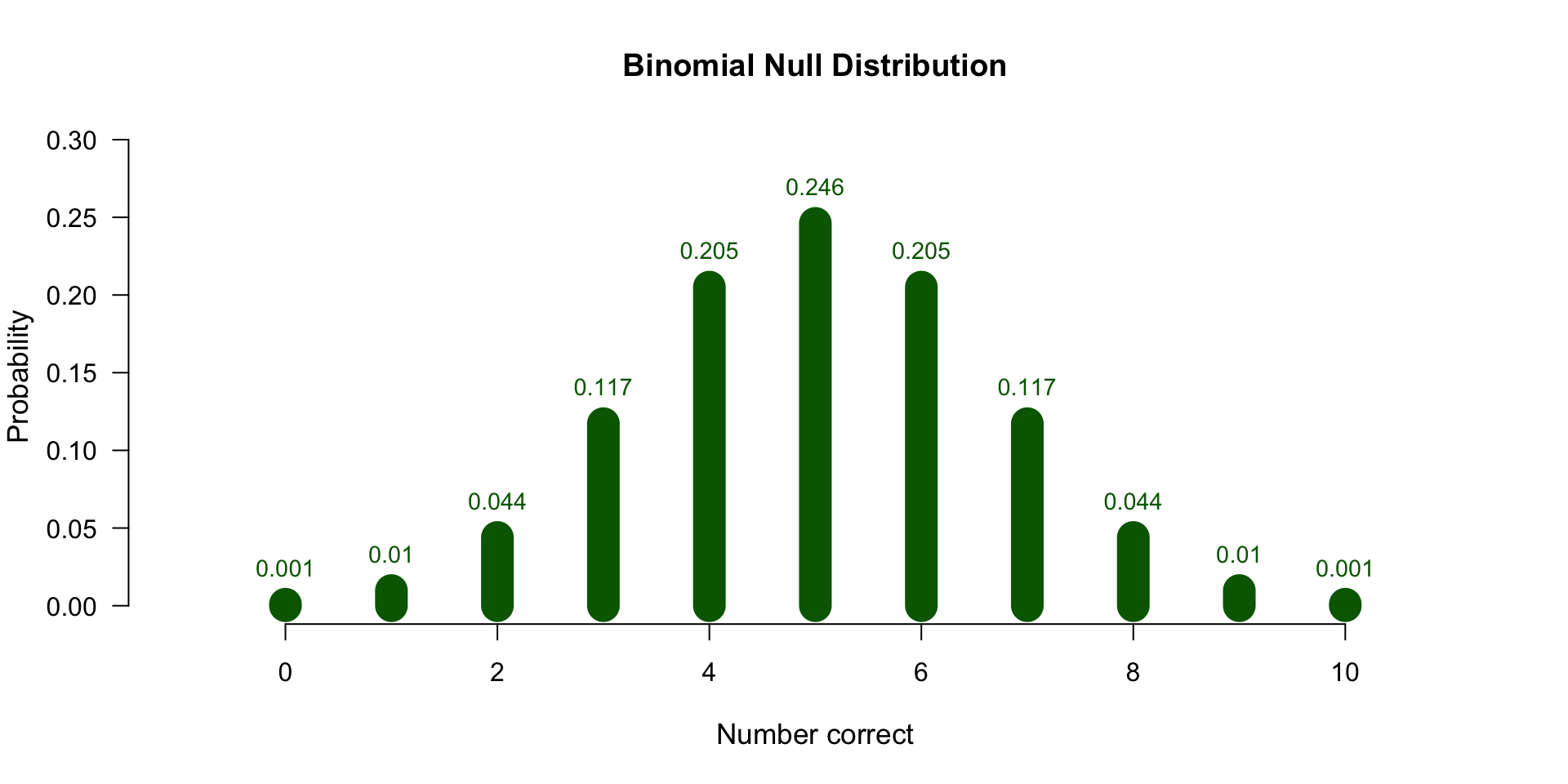
What we just did has a name
The number of correct answers is a test statistic.
A statistic that summarizes the data and is used for hypothesis testing, because we know how it’s distributed under different hypotheses
Common test statistics:
- Number of heads
- Sum of dice
- \(t\)-statistic
- \(F\)-statistic
- \(\chi^2\)-statistic
- etc…
What do those bar heights mean?
- Objective Probability
- Relative frequency in the long run
How surprising is the data?
Testing
The candidate had 8 items correct. Can we conclude they are a physics expert?
- As you can see from the distribution of novice scores, we cannot conclude that by definition.
- What we can do is indicate how rare 8 is in a novice.
Formulating the hypotheses
- If they are guessing (\(H_0\)), the expected value (EV) is 5 correct answers out of 10
- \(H_0: EV = 5\)
- If they are an expert, the EV is greater than 5 correct answers out of 10
- \(H_A: EV > 5\)
- We could also formulate our \(H_0\) and \(H_A\) more abstract:
- \(H_0:\) the candidate is novice
- \(H_A:\) the candidate is expert
Making the decision
- Due to getting ``lucky’’, a novice can also score greater than 5, but how strict should we be in our decision that someone is an expert?
- \(\alpha\)$ determines how strict we are in our decision to reject the null hypothesis (historically set to 5%).
- Candidate scored 8 items correct. If they would have been guessing, the probability to score 8 correct or more, is greater than 5%.
- Therefore, for \(\alpha = 0.05\) we conclude that our candidate is a novice, based on this trial.
P-value
Conditional probability of the observed test statistic or more extreme assuming the null hypothesis is true.
Reject \(H_0\) when:
- \(p\)-value \(\leq\) \(\alpha\)
P-value in \(H_{0}\) distribution
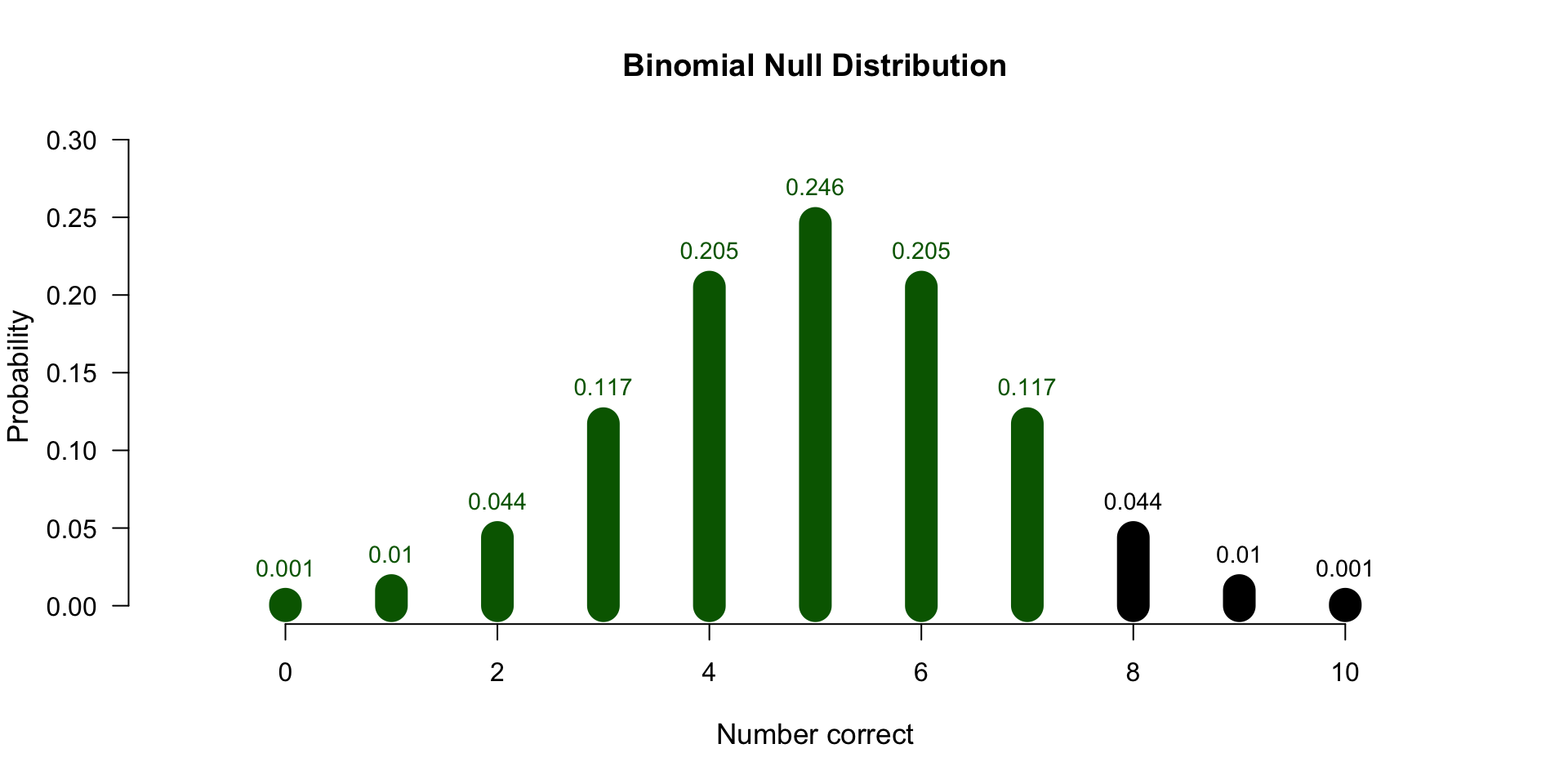
\[P(k \geq 8 \mid H_0) = 0.044 + 0.01 + 0.001 = 0.055\]
P-value and \(\alpha\)
Alpha determines how willingly we reject the null hypothesis:
- Increase \(\alpha\) = reject null hypothesis more often
- Increases Type I error rate
- Decreases Type II error rate
- Historically set to 0.05, but widely criticized (see Jane Superbrain 3.1)
No scientific worker has a fixed level of significance at which from year to year, and in all circumstances, he rejects hypotheses; he rather gives his mind to each particular case in the light of his evidence and his ideas. (Fisher, 1956)
\(\alpha\) dictates the rejection region
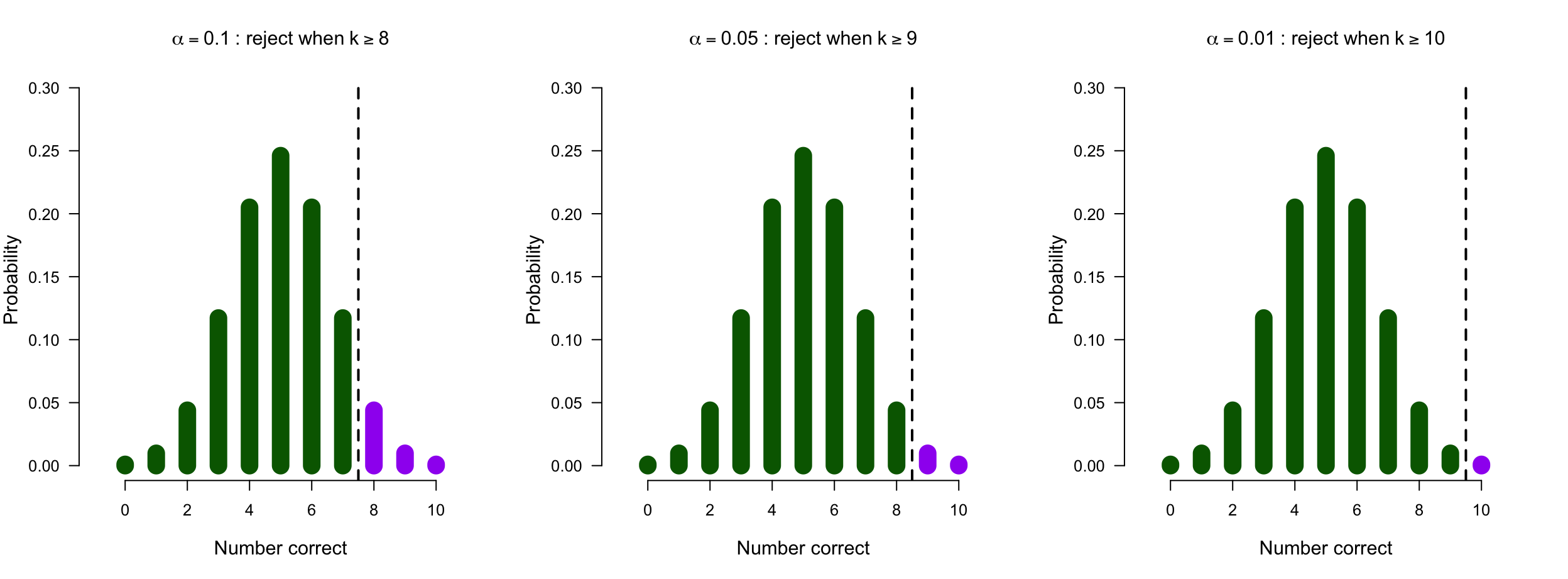
The stricter the \(\alpha\), the further into the tail the region starts. Our candidate’s 8 would only count as “significant” at \(\alpha = .10\).
Misconceptions about the p-value
- A significant result means that the effect is important
- Significance = effect size + sample size
- A non-significant result means that the null hypothesis is true
- A significant result means that the null hypothesis is false
What can go wrong?
Neyman-Pearson Paradigm

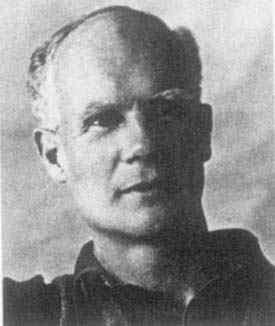
Fisher asked how surprising is this data? Neyman and Pearson asked a different question: which mistakes am I willing to make, and how often?
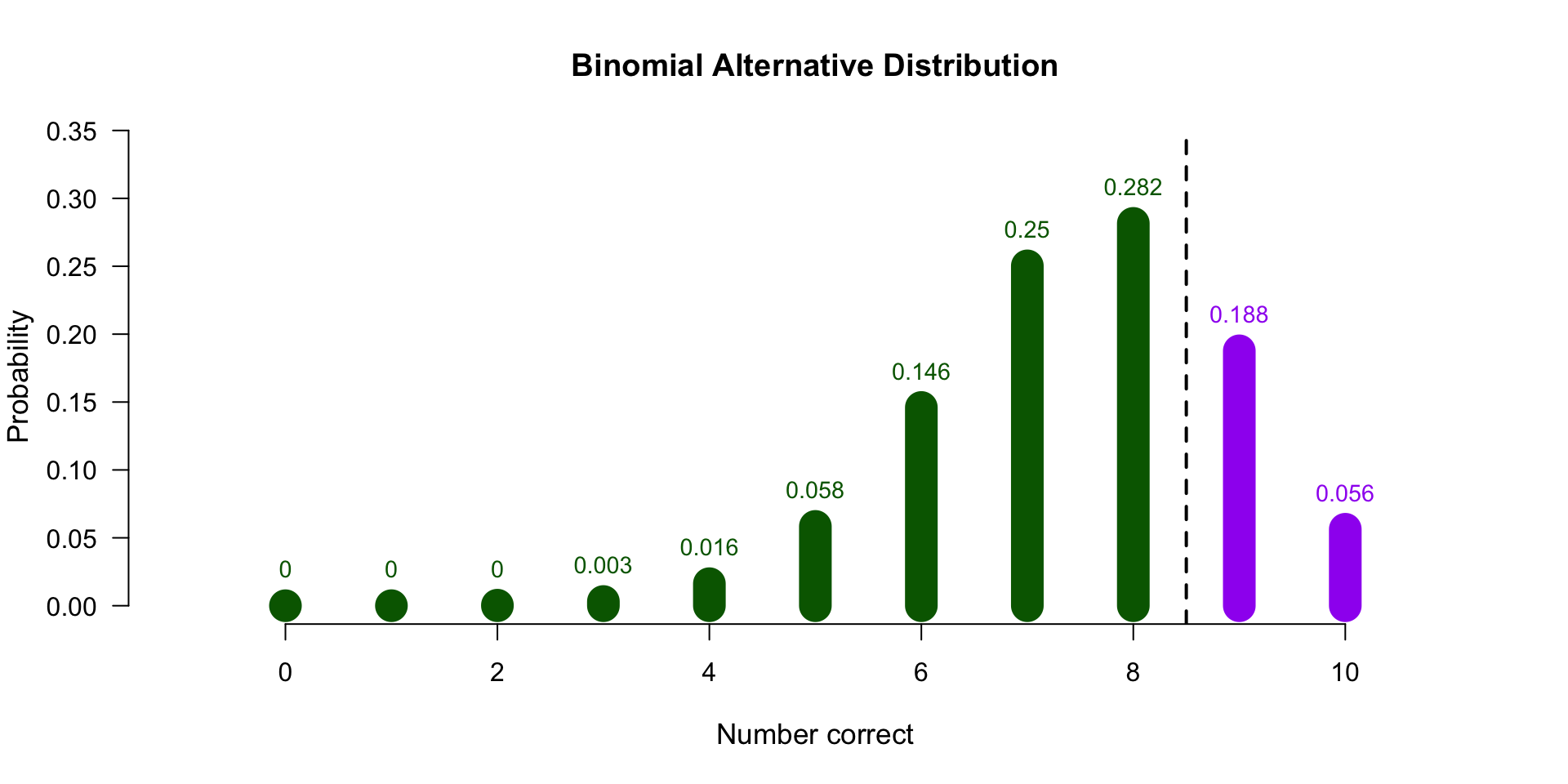
Alternative Distribution
But we have no clue what this distribution could look like.
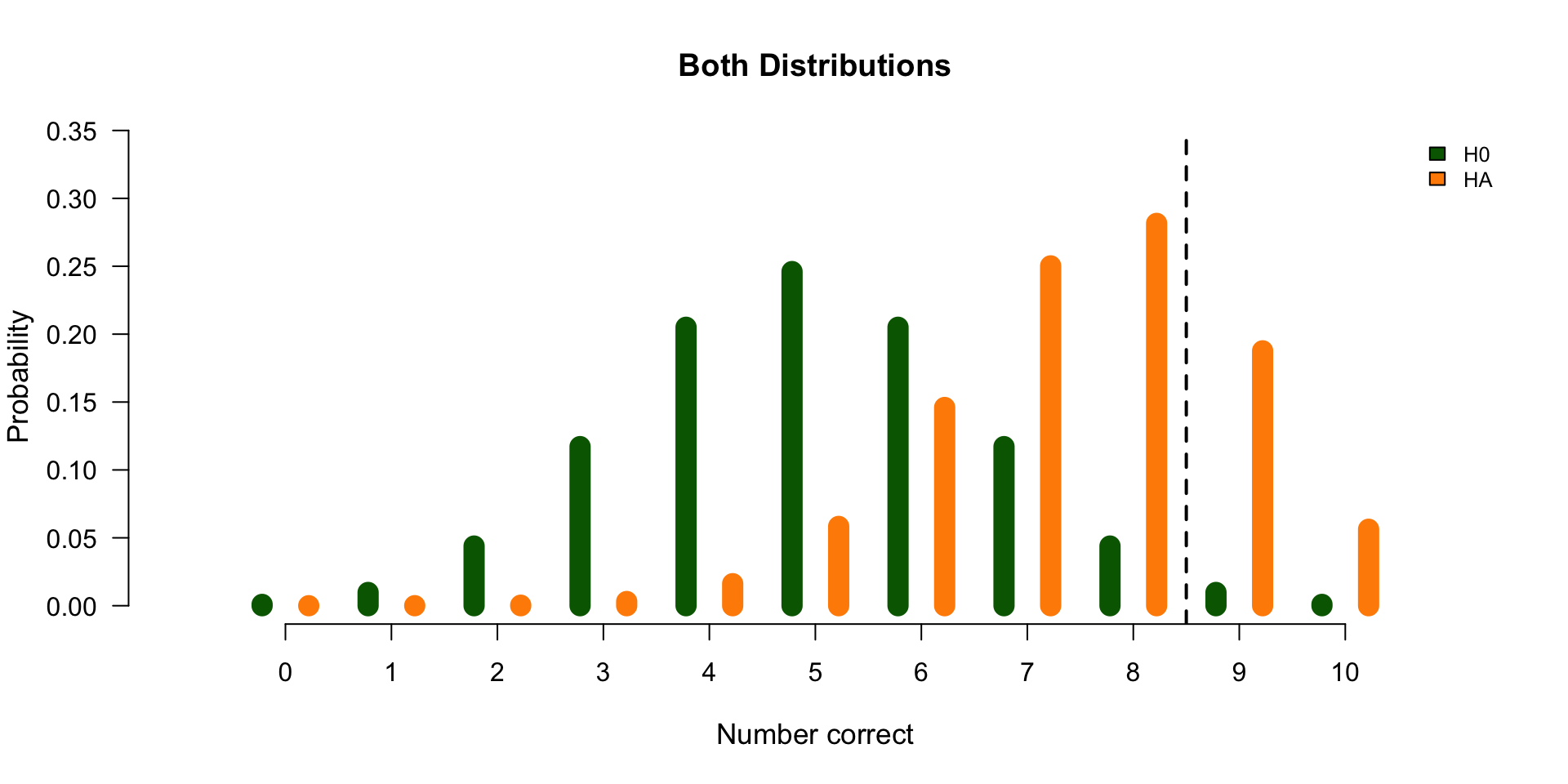
For now let’s assume the probability of answering an item correctly is .75
Both distributions at once
Decision table
The two ways to be wrong: \(\alpha\) and \(\beta\)
\(\alpha\) — Type I error
- Incorrectly reject \(H_0\)
- False positive
- Threshold for “significance”
- Criteria often 5% but heavily criticized
\(\beta\) — Type II error
- Incorrectly accept \(H_0\)
- False negative
- Criteria often 20%
- Distribution depends on sample size
The two ways to be right: power and \(1-\alpha\)
Power — correctly reject \(H_0\)
- True positive
- Power \(= 1 - \beta\)
- Criteria often 80%
- Depends on sample size
\(1-\alpha\) — correctly accept \(H_0\)
- True negative
Applet
Play around with this app to get an idea of the probabilities
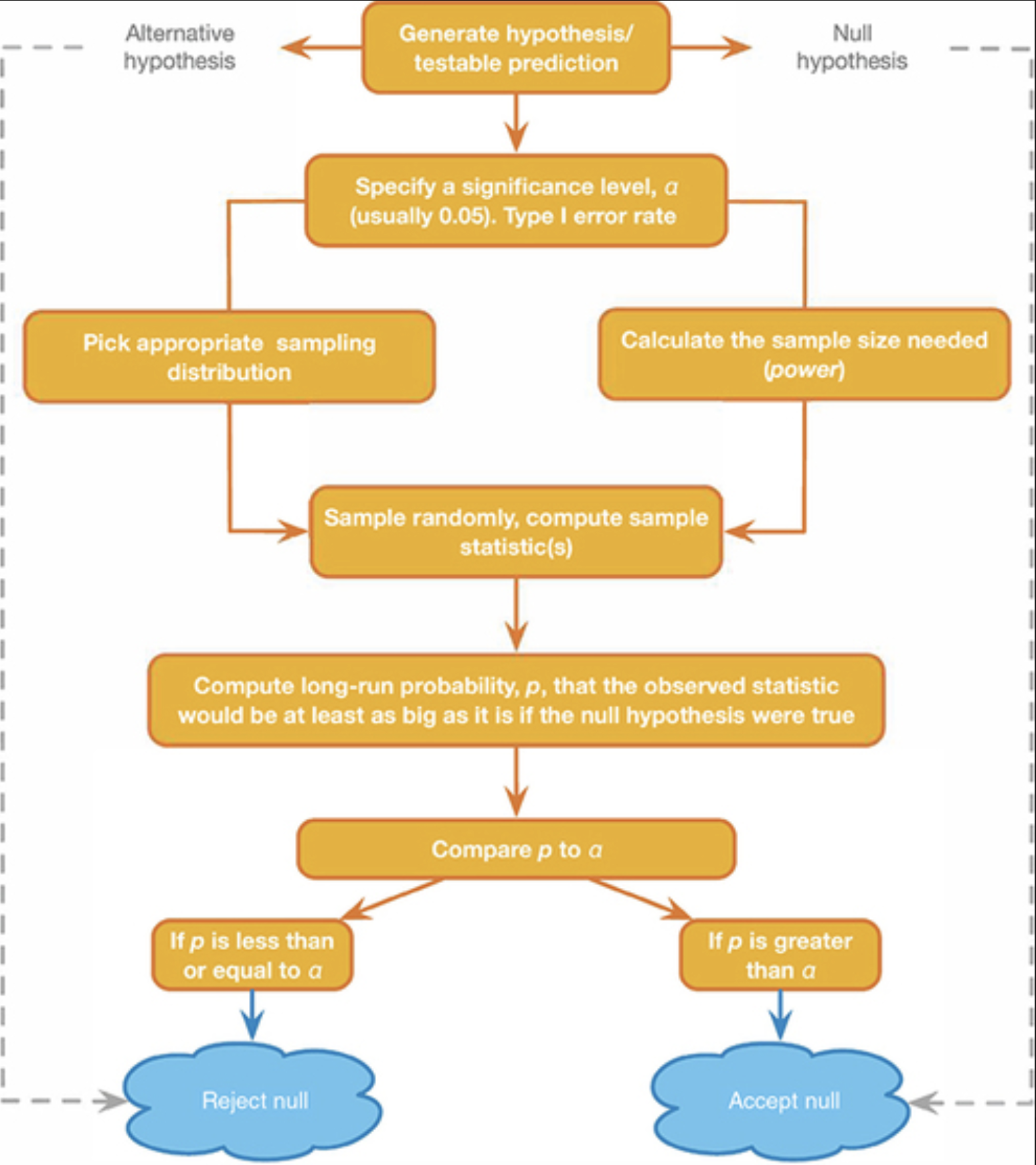
NHST Reasoning Scheme
Closing
Next Time
- JASP
- Descriptive statistics
- Data visualizations
- Describing and visualizing data
Bored?
Contact


Scientific & Statistical Reasoning